Raymond Sport
Raymond Sport

Since 1987 · UAE Sports Construction

Tennis Court Construction in the UAE

Tennis court construction is unforgiving of shortcuts — the base, the falls and the coating system decide how a court plays and how long it survives a UAE summer. Raymond Sport designs, builds and resurfaces tennis courts across Dubai, Abu Dhabi and the wider Emirates to International Tennis Federation (ITF) standards, using surface systems from Laykold, DecoTurf, California Sports Surfaces and Premier Coatings. Building here since 1987.
38+Years building UAE sports facilities
ITFPace-rated surface systems
TurnkeyBase, surface, fencing, lighting
GCCUAE, KSA, Qatar, Oman, Bahrain
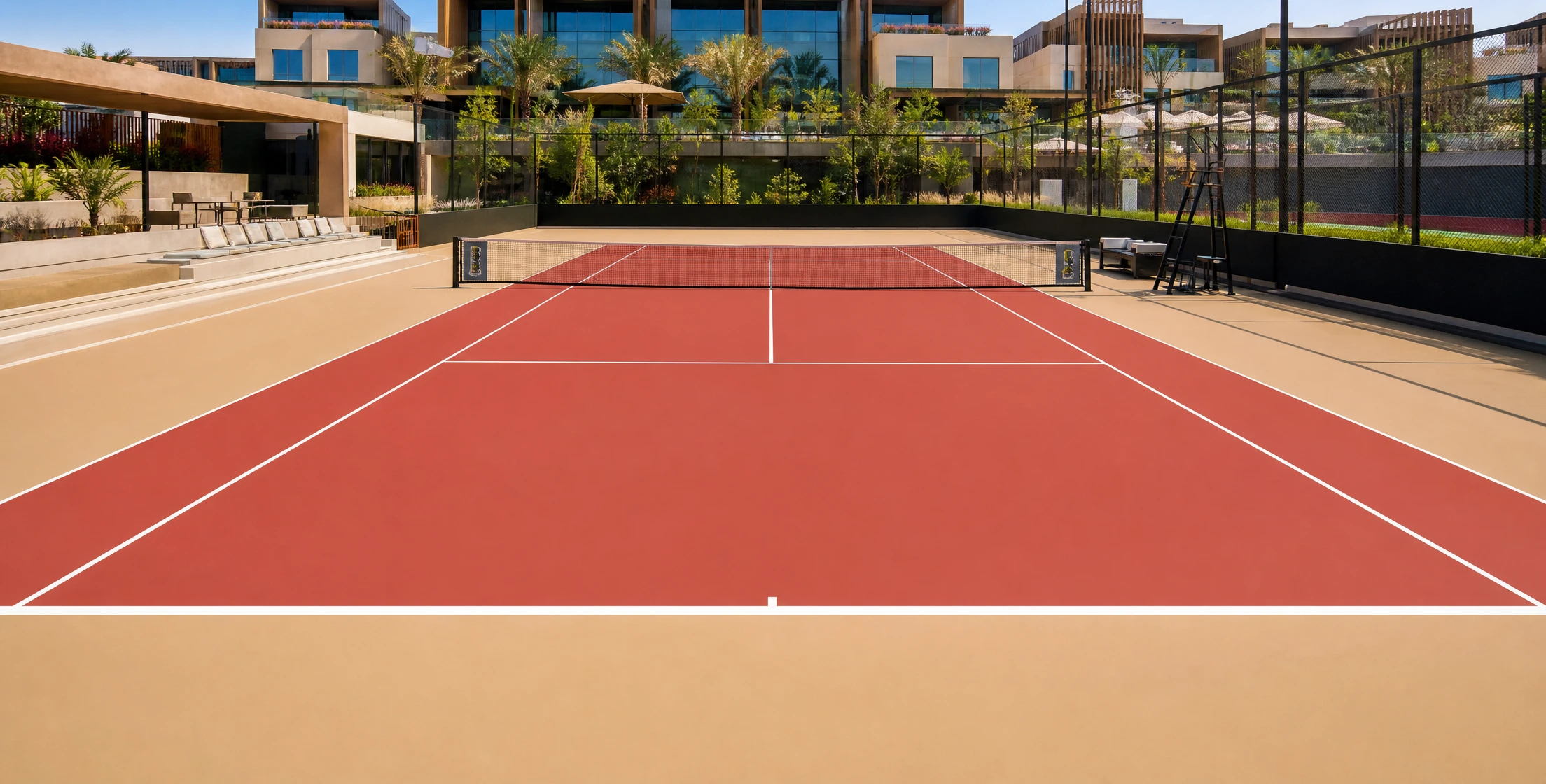
Tennis court construction by Raymond Sport at a sports facility in Dubai, UAE

Turnkey Tennis Court Construction, Start to Finish

A tennis court is a civil engineering job with a coating on top. We deliver both halves rather than laying paint over someone else's slab.

Scope of works for tennis court construction by Raymond Sport in the UAE
Stage Scope item Detail
Site Survey & Orientation Levels, drainage, access and sun path. North–south orientation is standard to keep low sun out of players' eyes.
Design & Specification Court count, surface system, pace rating, colour scheme, fencing and lighting — issued as drawings and a written schedule, not a one-line quotation.
Approvals Support Material submittals, method statements and compliance documentation prepared for consultant and authority review.
Critical Stage
Base Construction
Reinforced concrete or asphalt base, laid to tolerance with correct falls. This is the stage that decides whether the court holds water — and no coating system can rescue a base that was built wrong.
Surface System Primer, resurfacer, cushion layers where specified, colour coats and finish — applied to manufacturer specification, not approximated.
Line Marking ITF-compliant marking for singles and doubles play, set out and applied by trained applicators.
Net Posts, Nets & Fencing Ground sockets, competition net systems, perimeter fencing and windbreaks supplied and installed.
Lighting LED court lighting designed, installed and commissioned, with lux and uniformity measured on site and reported.
Handover & Warranty Snag list closed, as-built documentation, maintenance schedule and full warranty pack issued at handover.

Single point of responsibility. One contract, one team, one company accountable — from sub-base to final line.

Tennis Court Dimensions and ITF Standards

A regulation tennis court measures 23.77m long by 10.97m wide for doubles, and 8.23m wide for singles. The playing lines are only half the specification — total plot size, run-off and orientation matter just as much.

23.77 × 10.97 m

Doubles court
playing area

36.6 × 18.3 m

Recommended total plot
per court, with run-off

1.07 / 0.914 m

Net height
at posts / at centre

Tennis court dimensions and specifications to International Tennis Federation standards
Element Typical specification
Court size (doubles) 23.77m × 10.97m
Court size (singles) 23.77m × 8.23m
Recommended total plot Approximately 36.6m × 18.3m per court, to allow run-off
Run-off behind baseline 6.4m recommended for competition; less is acceptable for recreational courts
Run-off at sides 3.66m recommended for competition
Net height 1.07m at the posts, 0.914m at the centre
Base Reinforced concrete or asphalt, laid to falls
Surface pace ITF Pace Classification, Category 1–5
Fencing Typically 3–4m perimeter fencing, with optional windbreaks
Orientation North–south preferred to reduce low-sun glare

Compliance note. Confirm all dimensions and run-off requirements against current International Tennis Federation (ITF) rules and the requirements of the relevant national federation for your project. Raymond Sport issues a full compliance schedule with every proposal, covering dimensions, run-off, surface pace category and lighting levels.

Tennis Court Surfaces We Build

The surface decides how your court plays, how it feels underfoot and how often it needs attention. We specify it around who will use the court — not around what is in stock.
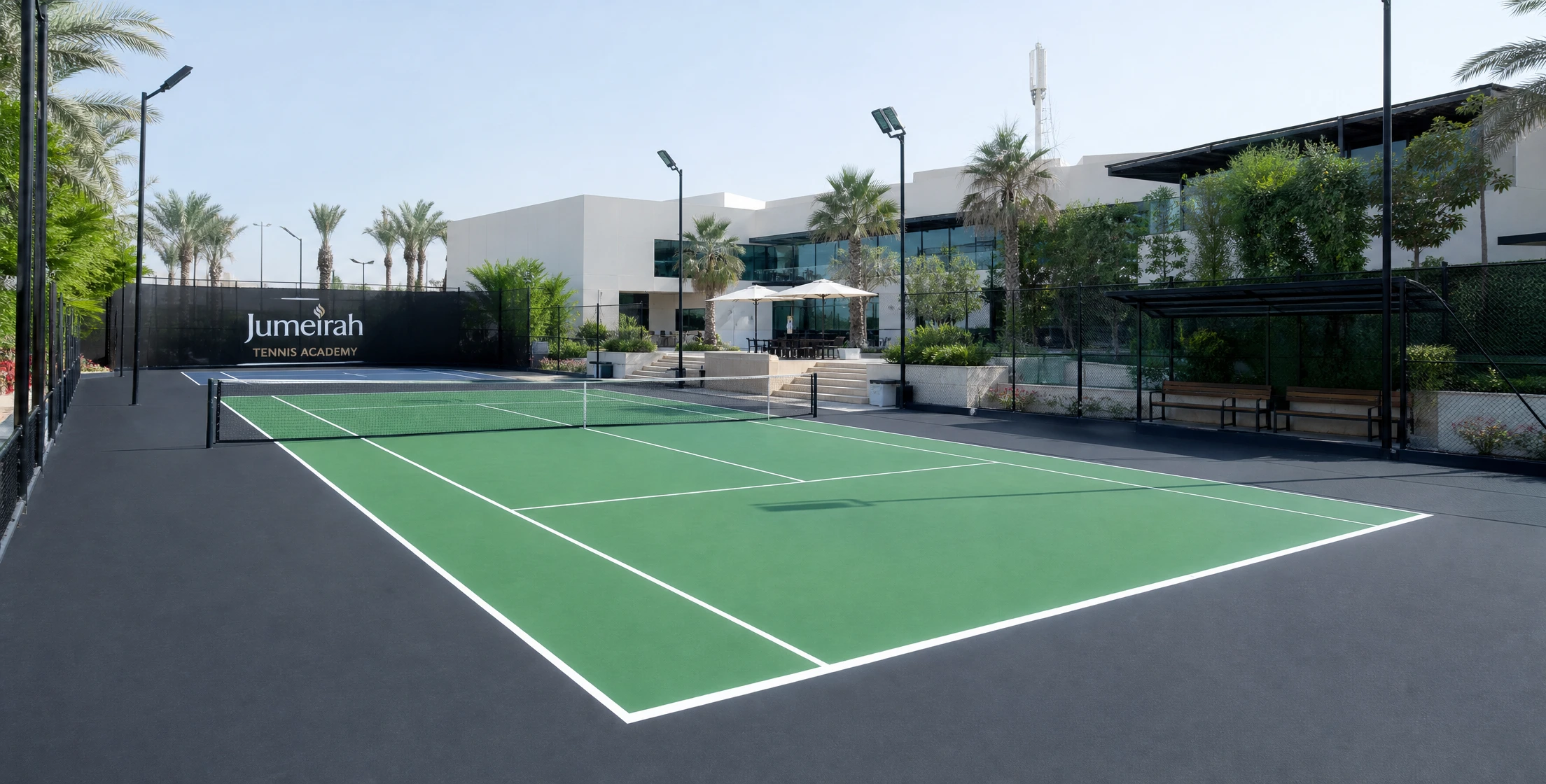
Acrylic hard tennis court surface installed by Raymond Sport in the UAE Most Specified

Acrylic Hard Court

The most widely specified surface in the UAE. Multi-layer acrylic over concrete or asphalt, available in a range of ITF pace ratings and colours. Durable, low maintenance and predictable in this climate.

Cushioned acrylic tennis court built for a club in Dubai by Raymond Sport Player Comfort

Cushioned Acrylic

The same acrylic finish over rubber cushion layers. Reduces impact loading on players' joints — preferred for clubs, schools and any facility with high daily playing hours. Higher cost, materially better underfoot.

Artificial clay tennis court installed in the UAE by Raymond Sport Slow Court

Artificial Clay

Synthetic carpet dressed with ceramic or clay-coated sand. Delivers slow-court playing characteristics with a fraction of the maintenance a natural clay court demands — the practical way to get clay-court play in the Gulf.

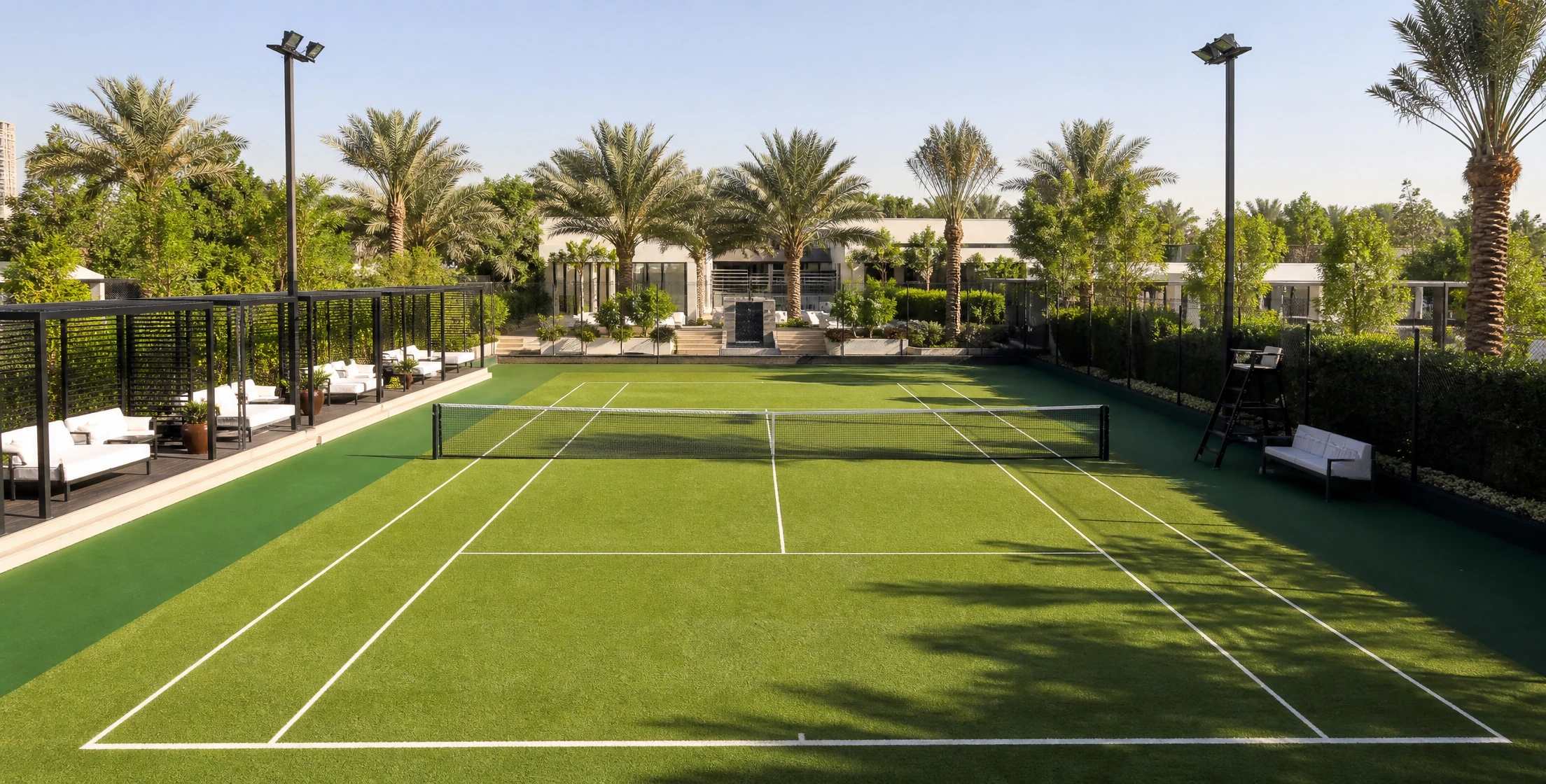
Artificial grass tennis court built at a residential property in the UAE by Raymond Sport Residential

Artificial Grass Court

Synthetic turf with sand dressing. Softer, quieter and more forgiving than a hard court — popular for residential and villa courts, and for multi-use family facilities where the court doubles as informal play space.

Tennis court resurfacing and recoating in progress in Dubai by Raymond Sport Existing Courts

Resurfacing & Recoating

For existing courts that have faded, cracked or lost pace. We assess the base, repair cracks, correct falls where possible and reapply the full coating system. Far less expensive than rebuilding — and in UAE conditions most courts need recoating long before the base fails.

Surface systems we specify and apply

Laykold
DecoTurf
California Sports Surfaces
Premier Coatings

ITF Pace Rating — Choosing How Your Court Plays

Surface pace is not a marketing term. The International Tennis Federation classifies court surfaces into five pace categories, and the category you choose changes the character of every match played on it.

ITF Pace Classification categories 1 to 5 for tennis court surfaces
Category Pace Plays like Typically specified for
Slow Longer rallies, higher bounce Clay-style courts, coaching and junior programmes
Medium-Slow Balanced, slightly favours baseline play Clubs and schools
Most Common in UAE
Medium
Neutral, all-court The most common specification for UAE clubs and hotels — suits mixed ability levels and social play.
Medium-Fast Rewards serve and attacking play Competition and performance facilities
Fast Low bounce, short rallies Specialist and indoor competition venues

We specify the pace category deliberately, based on who will use the court — not on whatever the supplier has in stock. Pace categories are defined by the International Tennis Federation; confirm the classification of any specific surface system against its current ITF test certificate.

Tennis Court Lighting

Tennis is a fast-ball sport played across a large area, so uniformity matters more than peak output. A court that measures 500 lux at the net and 200 at the baseline is a badly lit court, whatever the average says.

Typical illuminance targets for tennis courts by level of play
Level of play Illuminance target Typical application
Recreational / villa 200–300 lux Private and residential courts, compound and community facilities
Club and training 300–500 lux Clubs, hotels and resorts, schools and universities
Competition 500 lux and above Tournament and federation-affiliated venues
Broadcast Per event requirement Televised events, with flicker and colour rendering set by the broadcaster

Uniformity

Even end to end

A tennis court is nearly 24m long. Baselines and corners are where uniformity fails first, so that is where we measure.

Glare Control

Aimed off the serve line

Players look upward when serving and on overheads. Luminaires are aimed to keep the source out of that sightline.

Pole Positions

Clear of the run-off

Poles are set outside the playing and run-off zones, coordinated with the fence line at design stage rather than on site.

How we design it. Lighting is designed to EN 12193 classes, modelled before installation, and measured at commissioning — lux and uniformity reported, not assumed from the datasheet. Confirm the exact requirement with the relevant federation for any court intended to host sanctioned competition.

Tennis Court Maintenance in UAE Conditions

Hard courts are low maintenance, not no maintenance. This is the schedule we issue at handover — follow it and the coating reaches the top of its service life.

Weekly

  • Sweep debris and clear drainage channels
  • Check net tension and centre strap

Monthly

  • Wash the surface to remove dust film — a real issue in this region
  • Inspect line markings for wear at the baselines

Annually

  • Full inspection of coating, cracks and falls
  • Deep clean and check fencing and fixings
Resurfacing Due

Every 4–8 Years

  • Resurface and recoat, depending on sun exposure and playing hours
What Actually Ages a Court

UV exposure, not play, is the primary ageing factor on UAE hard courts. A court in full sun will need recoating sooner than its playing hours alone would suggest — and a lightly used villa court can reach the end of its coating life before a busy shaded club court does. If your surface has faded, chalked or lost pace, the base is usually still sound and a recoat is all it needs.

Why Build Your Tennis Court With Raymond Sport

Anyone can apply a coating. Far fewer can build the base underneath it. Five reasons clubs, hotels, schools and developers across the UAE appoint us to build and resurface their tennis courts.

38

Years in UAE
sports construction

Trading since 1987, with tennis courts delivered across Dubai and Abu Dhabi. Many of the courts we built a decade ago are courts we still maintain and resurface today — which is the only real test of whether they were built properly.

Manufacturer-Backed Systems

Laykold, DecoTurf, California Sports Surfaces and Premier Coatings — specified and applied to manufacturer requirements, not approximated.

Base and Surface, One Contractor

Most court failures start in the base. We build both, so there is nobody to blame but us.

Built for This Climate

Coating systems and drainage detailing selected for UAE heat and UV — not imported unchanged from Europe.

Dubai & Abu Dhabi Offices

Local teams, local supply chain, local aftercare and resurfacing — for the life of the court, not just to handover.

Trusted by leading UAE developers, government entities and hospitality groups

Emaar — Raymond Sport client Nakheel — Raymond Sport client DAMAC — Raymond Sport client Abu Dhabi Municipality — Raymond Sport client Dubai Police — Raymond Sport client Atlantis The Palm — Raymond Sport client

Tennis Court Construction: Frequently Asked Questions

The questions clients ask us most often before commissioning or resurfacing a tennis court in the UAE.

How much space do I need for a tennis court?

The court itself is 23.77m × 10.97m for doubles. Allow approximately 36.6m × 18.3m of total plot to include proper run-off behind the baselines and at the sides. Recreational courts can work with less run-off; competition courts cannot.

How long does it take to build a tennis court in the UAE?

Allow 8–12 weeks on site for a new court including base construction and curing time, assuming approvals and materials are in place. Resurfacing an existing court typically takes 1–2 weeks.

What is the best tennis court surface for the UAE climate?

Acrylic hard court, in most cases. It handles heat and UV predictably, needs little maintenance, and can be specified to any ITF pace category. Cushioned acrylic is worth the additional cost for any facility with high daily playing hours.

What is an ITF pace rating?

The International Tennis Federation classifies court surfaces into five pace categories, from Slow (1) to Fast (5). The rating describes how much the surface slows the ball and how high it bounces. Category 3, Medium, is the most commonly specified for UAE clubs and hotels.

How often does a tennis court need resurfacing in Dubai?

Typically every 4–8 years, depending on sun exposure, playing hours and how well the surface has been maintained. UV degradation, not play, is usually the limiting factor in this region.

Can you resurface an existing tennis court rather than rebuild it?

Yes, and it is usually the right answer. If the base is sound, Raymond Sport repairs cracks, corrects falls where possible and reapplies the full coating system at a fraction of the cost of a new court.

Do you build indoor tennis courts?

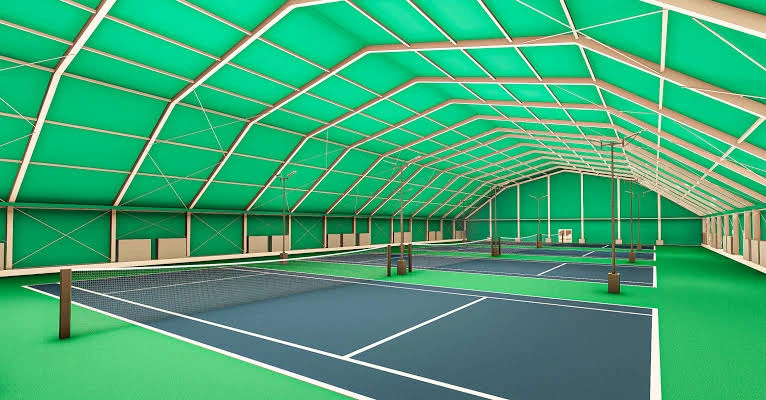
Yes. Indoor courts require a minimum clear height over the court — confirm the requirement for your intended level of play — plus lighting and ventilation designed to avoid glare and heat build-up.

Do you build tennis courts outside the UAE?

Yes. We deliver across the GCC, including Saudi Arabia, Qatar, Oman, Bahrain and Kuwait.

Still have a question about your court? Send us your site details and our team will come back with a surface specification and a programme.

Cart (0 items)