Since 1987 · UAE Sports Construction
Volleyball Court Construction in the UAE
Volleyball is three different builds wearing the same name. An indoor court is a sprung floor and seven metres of clear height. An outdoor court is a UV-stable hard surface and a wind-aware layout. A beach court is 400mm of washed sand, a drainage layer and an anchoring system that holds under load. Raymond Sport builds all three across Dubai, Abu Dhabi and the wider UAE, to FIVB dimensions — floor or sand, posts, net systems, padding and lighting under one contract. Building sports facilities here since 1987.
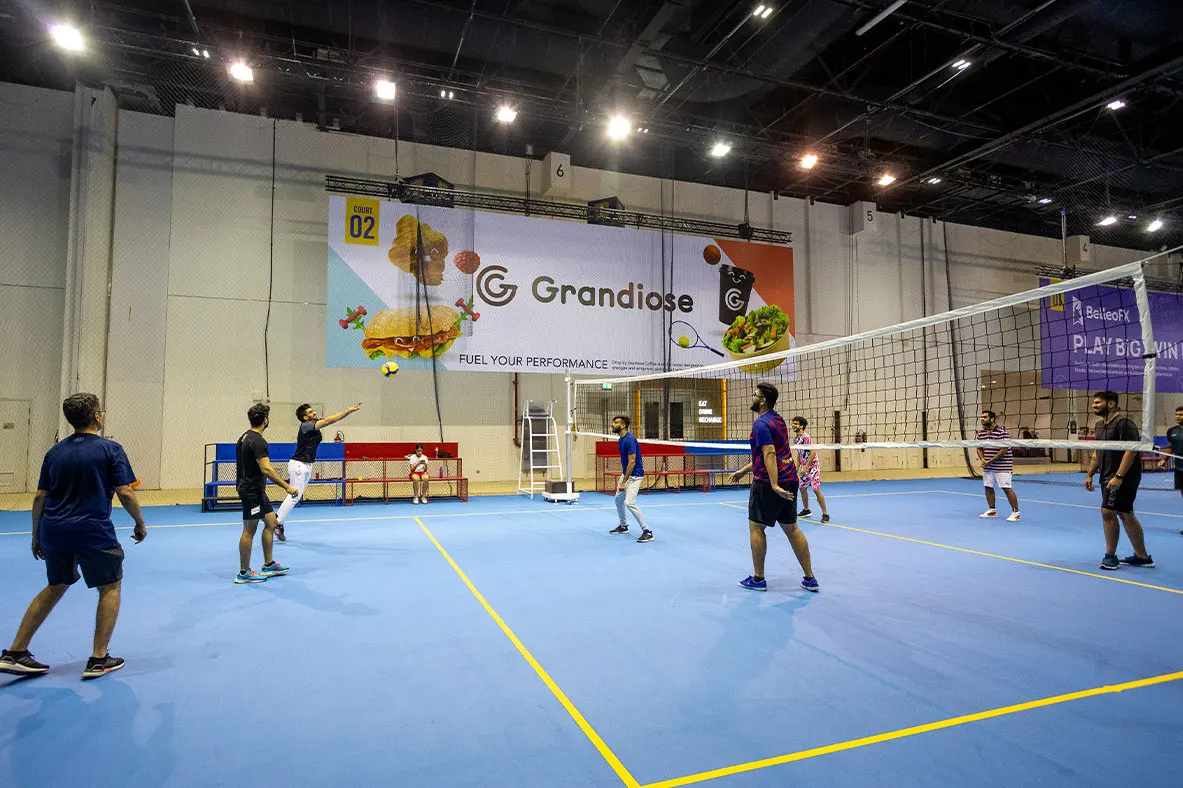
Three Court Types, Three Different Builds
The first question is not what surface you want. It is where the court is going. Everything downstream — cost, programme, constraints and how the game actually plays — follows from that.
| Consideration | Indoor Competition surface | Outdoor hard court Schools & community | Beach / sand Resorts & beach clubs |
|---|---|---|---|
| Typical surface | Sprung wood or point-elastic vinyl | Acrylic or modular tile over concrete | Washed, screened silica sand |
| Governing constraint | Clear height above the court | UV stability and wind | Sand depth, drainage and anchoring |
| Typical venue | Schools, sports halls, clubs | Community courts, schools, MUGAs | Beach clubs, resorts, hotels |
| Climate factor | Requires HVAC | UV-stable coatings and shade planning | Sand heat, and drainage after rain |
| Playing standard | Highest — the competition surface | Very good for recreational and school play | A different sport, effectively |
| Maintenance | Sweep, damp mop, periodic refinish | Wash, inspect, recoat every few years | Rake, level, top up sand, check anchors |
Beach volleyball is not indoor volleyball on sand. The court is smaller, the teams are smaller, the game is different, and the build has almost nothing in common with a hard court — different excavation, different drainage, different anchoring, different everything. It is the one court type most often specified by someone who has only ever built the other two, and it is why we have given it its own section below.
Volleyball Court Dimensions and FIVB Standards
An indoor volleyball court is 18m long by 9m wide. The playing area is the easy part — the free zone around it and the clear height above it are what most sites get wrong.
18 × 9 m
Indoor court
playing area
2.43 / 2.24 m
Net height
men's / women's
7 m
Minimum clear height
above the court
| Element | Typical specification |
|---|---|
| Court size | |
| Court size (indoor) | 18m × 9m |
| Court size (beach) | 16m × 8m — smaller, and a different game |
| Space around and above | |
| Free zone (recreational) | Minimum 3m on all sides |
| Free zone (international) | 5m at the sidelines, 6.5m at the end lines |
| Minimum clear height | 7m above the playing area |
| Clear height (top-level competition) | Considerably greater — confirm for your level of play |
| Net, lines and equipment | |
| Net height (men) | 2.43m |
| Net height (women) | 2.24m |
| Attack line | 3m from the centre line |
| Posts | Set 0.5–1m outside the sidelines, padded |
| Antennae | Fitted to the net at the sideline extensions |
A hall can be exactly 18m × 9m with the correct free zone and still be unusable. If there is a beam, a duct or a light fitting at six metres, the court does not work — and no amount of floor specification fixes it. We measure to the lowest obstruction, not to the slab.
Compliance note. Confirm all dimensions, net heights, free zone and clear height requirements against current FIVB rules and the requirements of your national federation — youth and veteran categories use different net heights. Raymond Sport issues a full compliance schedule with every proposal.
Indoor Volleyball Courts
Volleyball indoors is played jumping and landing, repeatedly. Three surface systems handle that well — and which one is right depends less on volleyball than on what else the hall has to do.
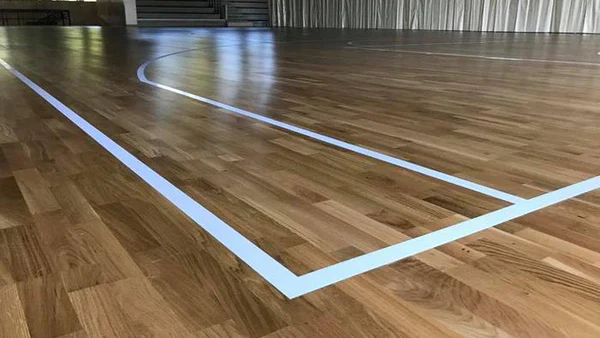
Shared Halls
Sprung Wood
The reference surface, shared with basketball. Area-elastic, engineered to EN 14904 for shock absorption and vertical deformation. Specified where the hall also hosts basketball and the floor is the primary investment.
Best whenThe hall is a genuine multi-sport space and basketball leads.
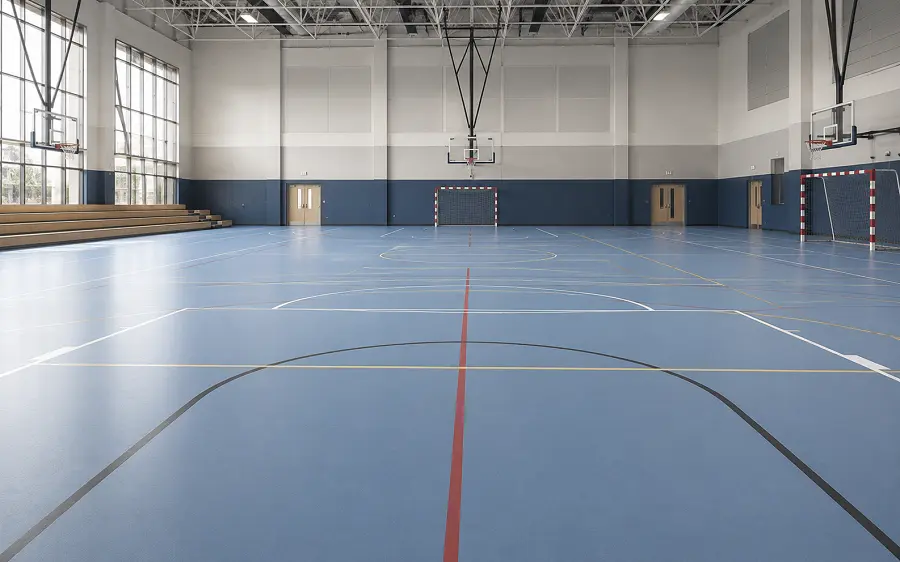
Volleyball First
Point-Elastic Vinyl
Sheet or roll vinyl over a resilient backing — the surface most associated with modern indoor volleyball. Consistent underfoot across the whole court, excellent grip for lateral movement, easier to maintain than timber and less sensitive to humidity.
Best whenVolleyball is the priority sport, or humidity control is imperfect.
Heavy Use
Poured Polyurethane
Seamless PU over a prepared base. Hard-wearing, easy to clean and forgiving of an imperfect sub-floor. Common in multi-purpose halls that take heavy non-sport use — assemblies, exams, events.
Best whenThe hall is used for far more than sport.
- If the hall is shared with basketball and the floor is the main investment — sprung wood. It is the surface both sports were designed around.
- If volleyball is the priority, or you cannot guarantee stable humidity year-round — point-elastic vinyl. It gives up little in performance and asks far less of the building.
- If the hall doubles as an assembly space, exam room or events venue — poured PU. It will take furniture, footfall and cleaning that would ruin a timber floor.
Outdoor Volleyball Courts
Outdoor courts are cheaper, faster and far more common on UAE school and community sites — and they are frequently marked onto a MUGA rather than built standalone.
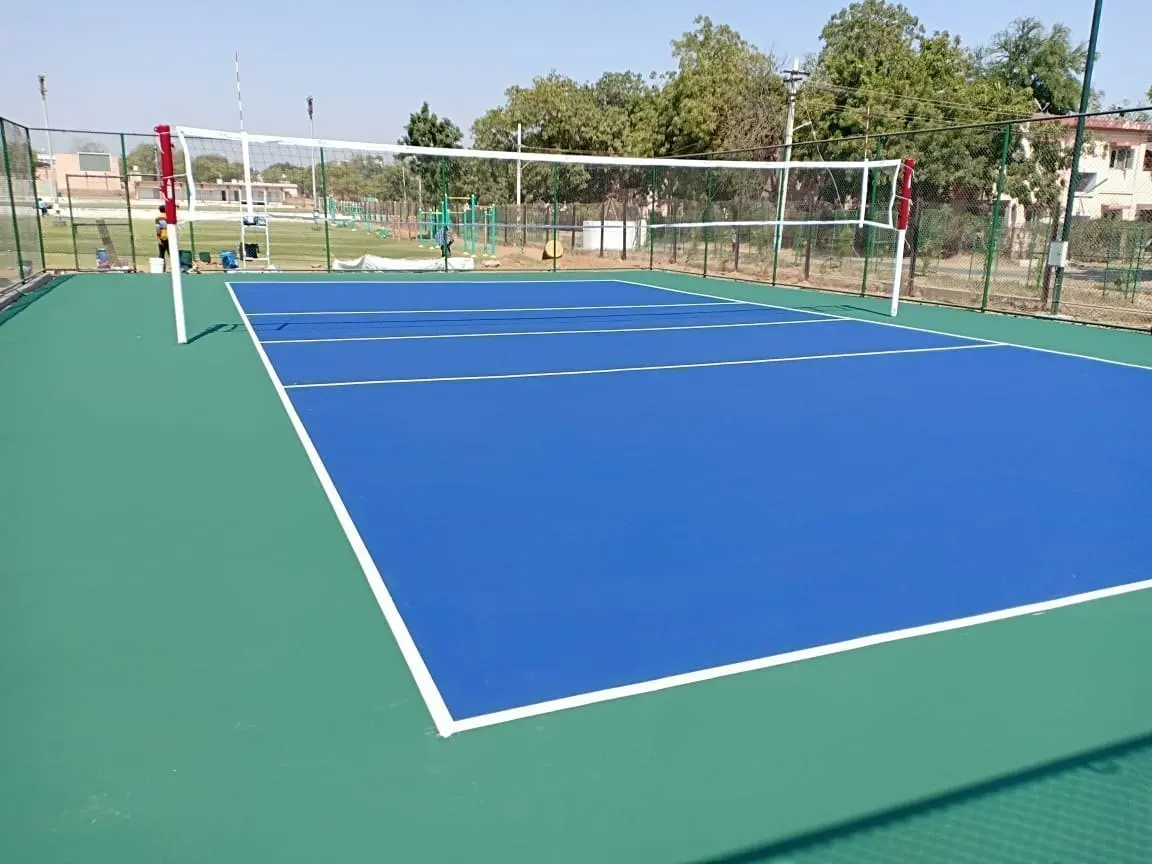
Acrylic Over Concrete
StandardUV-stable, low maintenance and the standard UAE outdoor system. Laid in full colour schemes, with the court and free zone marked as one surface.
Modular Tile
Fast InstallInterlocking polypropylene. Fast to install, drains well and replaceable panel by panel — useful where a single area takes heavy localised wear.
Overmarked on a MUGA
Most EconomicalThe cheapest route by a wide margin where volleyball is a secondary sport. Usually only needs post sockets and net provision adding to a multi-sport court you are already building.
nobody plans for
An exposed outdoor court in the UAE will play badly on a windy afternoon — volleyball is the lightest ball on any court we build, and it is the sport most affected. Orientation, shade structures and adjacent buildings all change how usable the court actually is. They are worth thinking about before the slab goes in, because none of them can be added cheaply afterwards.
Beach Volleyball Court Construction
A beach volleyball court looks like the simplest build in sport. It is not. Under the sand there is excavation, containment, drainage and structural anchoring — and the sand itself is a specification, not a delivery.
| Component | What we specify | Why it matters |
|---|---|---|
| Court size | 16m × 8m playing area | Smaller than indoor — it is a different game |
| Free zone | 5m minimum recommended | Players play the ball outside the court constantly |
| Excavation | Dug to depth, level contained perimeter | The perimeter has to hold the sand in for years |
| Drainage layer | Below the sand, sized for the site | Rain has to leave, or the court becomes a pond |
| Sand | Washed and screened, correct grain size and roundness | Wrong sand compacts, cuts feet or blows away |
| Sand depth | Typically 400mm minimum | Too shallow and players hit the base when they dive |
| Posts & anchoring | Ground-anchored system, padded posts | Sand offers no resistance — anchoring is structural |
| Boundary lines | Tensioned webbing, not paint | The only line system that works on sand |
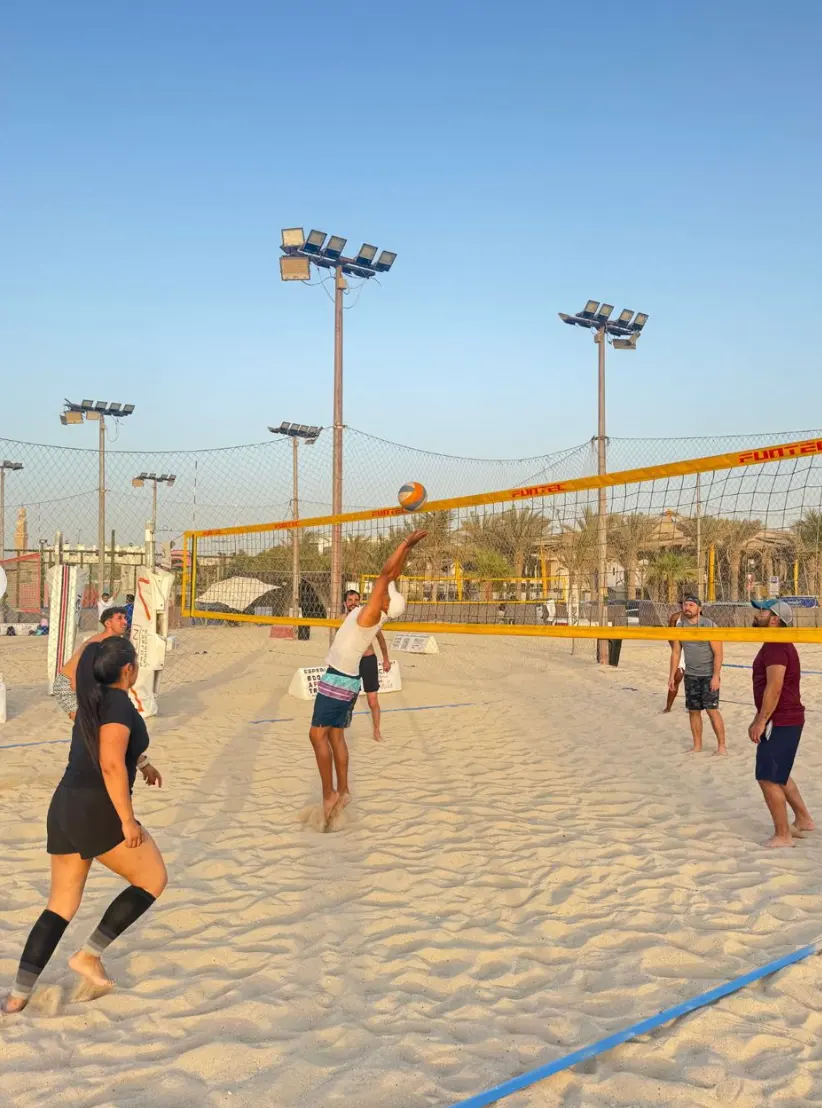
Sand is the single largest determinant of whether a beach court is any good, and the most common thing to get wrong. Builder's sand is cheap and unplayable — it compacts under foot, it holds moisture, and it will not drain. What you get is a hard, heavy court that punishes players for diving, which is the entire point of the game. Washed, screened, correctly graded sand is not an upgrade. It is the product.
Who builds these
Sand courts are a hospitality product as much as a sports one — they photograph well, they fill an underused corner of a site, and guests use them without booking or instruction. If you have beachfront, or a landscaped area that can be drained, a sand court is usually achievable.
Volleyball Court Lighting
Volleyball is played looking up. More than any other court sport, players track a ball above the horizontal for most of a rally — which changes where the luminaires can go.
| Level of play | Illuminance target | Typical application |
|---|---|---|
| Recreational / community | 200–300 lux | Community and residential courts, resort sand courts |
| School and club | 300–500 lux | School halls, clubs and universities |
| Competition | 500 lux and above | League and federation-affiliated venues |
| Top-level / broadcast | Considerably higher | Confirm the requirement — international competition levels are set by the federation and the broadcaster |
Luminaires positioned out of the overhead sightline and protected against ball strike. On a court where every serve, set and block is tracked upward, a fitting in the wrong place is not a nuisance — it is a lost point.
Pole positions have to sit outside a generous free zone — players leave the court constantly on sand. Light spill matters where courts sit near guest accommodation, which is most resort sites.
On a basketball court players look up at one point — the ring. On a volleyball court the ball is above head height for most of the rally, anywhere across the width of the court. There is no single sightline to design around, which is why volleyball lighting is laid out to avoid glare from every position rather than from one.
How we design it. Lighting is designed to EN 12193 classes, modelled before installation, and measured at commissioning — lux and uniformity reported, not assumed from the datasheet. Confirm the exact requirement with the relevant federation for any court intended to host sanctioned competition.
Volleyball Court Maintenance
Three court types, three different regimes. The sand court is the one that needs attention weekly — and the one most often handed over without anyone explaining that.
| Interval | Indoor | Outdoor hard | Beach / sand |
|---|---|---|---|
| Weekly | Dust mop; check net tension | Sweep; clear drainage | Rake and level the sand; check anchors |
| Monthly | Damp mop; inspect posts and sockets | Wash surface; inspect lines | Check sand depth at the net and baselines |
| Annually | Full floor and fixings inspection | Full coating and drainage inspection | Top up sand; full drainage and anchor check |
| Major Works Every 4–8 Years |
Refinish or resurface | Resurface and recoat | Sand replacement or major top-up |
for topping up
Sand migrates. Players carry it out on feet and towels, wind moves it, and over time most of it ends up outside the court. Topping up is a routine operating cost, not a failure — and a court that is raked weekly and topped up annually will play well for years. One that is left alone compacts at the net, thins at the baselines, and stops being safe to dive on.
Existing court not playing well? Tell us the court type and what the problem is. Sand depth, net tension and drainage are usually quick fixes; surface wear is not.
Book a Court AssessmentWhy Build Your Volleyball Court With Raymond Sport
Most contractors in this market build one type of volleyball court and adapt it to the others. We specify all three on their own terms — because a sand court and a sprung floor have almost nothing in common.
38
Years in UAE
sports construction
Trading since 1987, with courts delivered for schools, clubs, resorts and developments across Dubai and Abu Dhabi. Long enough to have built volleyball into sports halls, community parks and beachfront — three completely different problems, all of them ours.
Indoor, Outdoor and Beach
They are genuinely different builds. Most contractors do one and adapt; we specify each on its own terms, and we will tell you when the one you asked for is the wrong one.
We Build for Hospitality
Beach clubs, resorts and hotels are a core part of what we do in the UAE. A sand court has to survive guest use, not just competition play — and those are different specifications.
Clear Height Checked First
On indoor courts we measure to the lowest obstruction before anything is designed — because that, not floor area, is what makes a hall usable or not.
Dubai & Abu Dhabi Offices
Local teams, local supply chain, and local aftercare, sand top-ups and resurfacing — including the annual work a sand court actually needs.
Trusted by leading UAE developers, government entities and hospitality groups
Volleyball Court Construction: Frequently Asked Questions
The questions schools, clubs and resorts ask us most often before commissioning an indoor, outdoor or sand volleyball court in the UAE.
What are the dimensions of a volleyball court?
An indoor court is 18m long by 9m wide, with a free zone of at least 3m on all sides for recreational play and more for international competition. Beach volleyball courts are smaller at 16m × 8m. You also need at least 7m of clear height above an indoor court.
How high is a volleyball net?
2.43m for men's play and 2.24m for women's. Youth and veteran categories use different heights, so confirm the requirement for your level of play before the posts are set — it is not something that can be adjusted easily afterwards.
How much space do I need for a volleyball court?
More than the court itself. For a recreational indoor court, allow the 18m × 9m playing area plus a 3m free zone on every side — roughly 24m × 15m of clear floor, with 7m of unobstructed height above it. Competition courts need considerably more.
Can you build a beach volleyball court in the UAE?
Yes, and it is one of the more popular facilities we build for resorts, beach clubs and hotels. It needs excavation, a contained perimeter, a drainage layer, correctly graded washed sand at around 400mm depth, and a ground-anchoring system for the posts. If you have beachfront — or a landscaped area that can be drained — it is usually achievable.
What sand is used for a beach volleyball court?
Washed and screened sand with the correct grain size and roundness. Builder's sand is not suitable — it compacts, holds moisture and does not drain, which makes the court hard, heavy and unpleasant to play on. The sand specification is the single biggest factor in how a beach court plays.
How deep should the sand be on a beach volleyball court?
Typically a minimum of 400mm. Too shallow and players reach the base when they dive, which is both uncomfortable and unsafe — and diving is the part of the game the surface exists to allow.
Can volleyball be marked onto an existing court?
Yes. Volleyball is one of the most commonly overmarked sports on a MUGA or a basketball court, and it usually only needs post sockets and net provision adding. It is by far the most economical route where volleyball is a secondary sport.
Do you build volleyball courts outside the UAE?
Yes. We deliver across the GCC, including Saudi Arabia, Qatar, Oman, Bahrain and Kuwait.
Not sure which court type suits your site? Tell us the space you have and who will use it. We will tell you whether indoor, outdoor or sand makes more sense — and whether it fits.
Ask Our Team