Since 1987 · UAE Sports Construction
Padel Court Construction in the UAE
Raymond Sport designs, supplies and installs padel courts across Dubai, Abu Dhabi and the wider UAE — built to International Padel Federation (FIP) dimensions, engineered for 45°C summers, and delivered as a single turnkey package by a team that has been building sports facilities in the Emirates for 38 years.
Turnkey Padel Court Construction, Start to Finish
We handle the whole build, not just the kit. That matters on padel more than most sports, because the majority of court failures in this region trace back to the slab and the drainage rather than the court system itself.
01
Site Survey & Feasibility
Levels, access, existing services, orientation and drainage assessed before anything is priced.
02
Structural & Civil Coordination
We work directly with your consultant and structural engineer on loadings, setting out and interfaces.
03
Sub-Base, Slab & Drainage
Compacted sub-base, reinforced concrete slab and drainage falls built to tolerance. The stage that decides court life.
04
Galvanised Steel Structure
Hot-dip galvanised frame specified for Gulf humidity and coastal exposure, set out and levelled on site.
05
Tempered Glass & Mesh
10mm or 12mm tempered safety glass panels with mesh fencing, installed to FIP enclosure heights.
06
Artificial Turf & Infill
UV-stabilised monofilament turf laid, seamed and line-marked, then infilled with silica sand and brushed to set the pile.
07
LED Floodlighting
Lighting designed to target lux and uniformity, supplied, installed, aimed and commissioned with on-site measurement.
08
Nets, Posts, Gates & Accessories
Competition-grade net systems, tensioning, access gates and court furniture supplied and fitted.
09
Handover & Warranty
Snag list closed, as-built documentation, maintenance schedule and full warranty pack issued at handover.
Single point of responsibility. One contract, one team, one company accountable for the finished court — from the ground up to the last light fitting.
Padel Court Dimensions and FIP Standards
A regulation padel court is 20 metres long by 10 metres wide, divided into two 10m × 10m halves by the net. The playing area is fully enclosed by a combination of tempered glass and mesh.
| Element | Typical specification |
|---|---|
| Overall court size | 20m × 10m playing area |
| Recommended total footprint | Approximately 21m × 11m to allow for structure and safe access |
| Net height | 88cm at the centre, 92cm at the posts |
| Back wall height | 3m tempered glass, with mesh above to 4m |
| Side wall height | 3m for the first 2m from each back wall, stepping down to 2m |
| Glass thickness | 10mm or 12mm tempered safety glass |
| Structure | Hot-dip galvanised steel, specified for Gulf humidity and coastal exposure |
| Service line | 3m from the back wall |
| Minimum clear height (indoor) | 6m recommended over the full court |
Compliance note. Specifications should always be confirmed against the current International Padel Federation (FIP) rules and the requirements of the relevant national federation for your project. Raymond Sport prepares a full compliance schedule with every proposal, covering dimensions, materials, glass certification and lighting levels.
Types of Padel Court We Build
From standard club courts to full-glass panoramic installations and rooftop builds in Dubai — we specify and construct every padel court format used across the UAE.
Most Specified
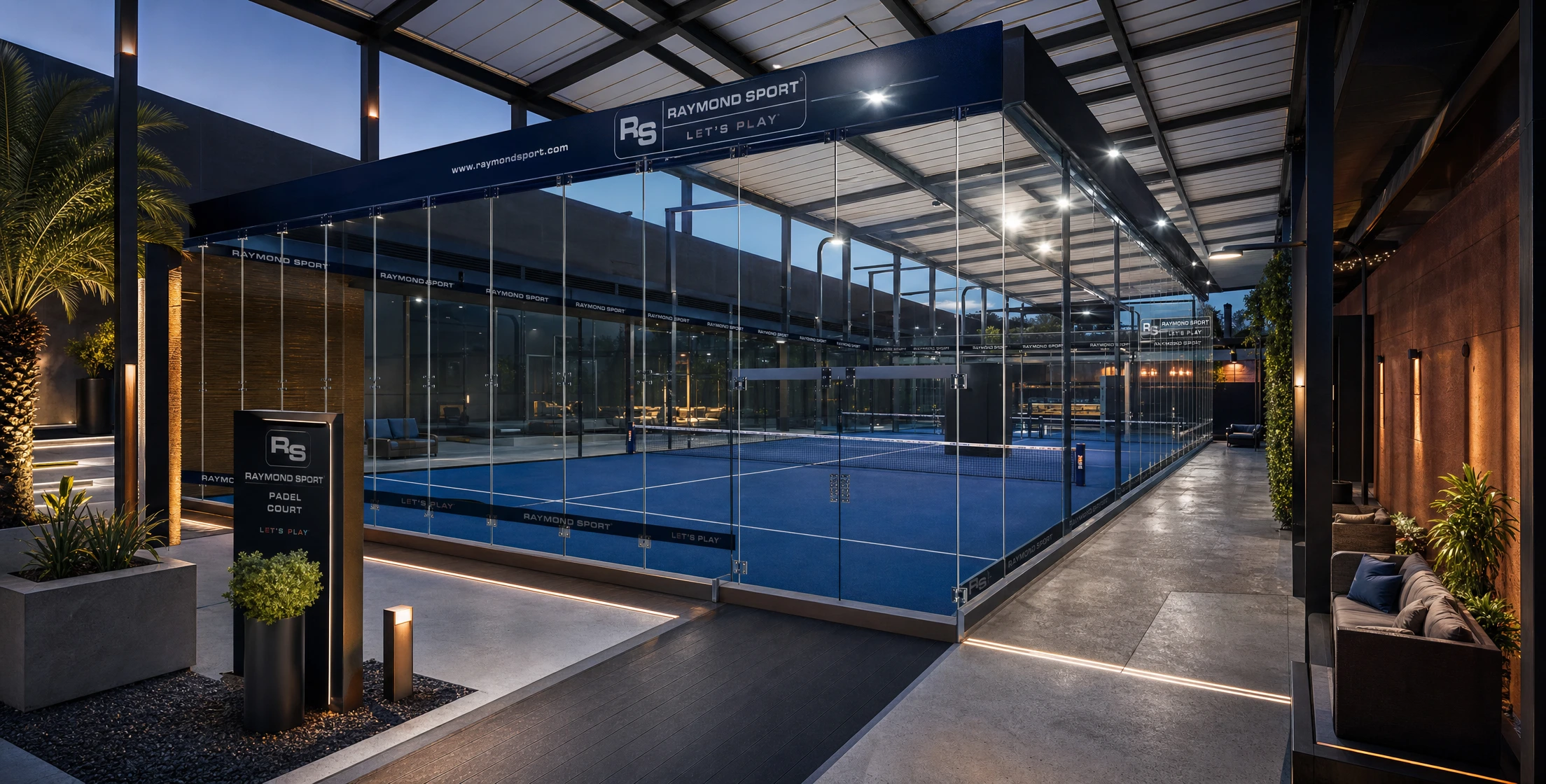
Standard Double Court
The default configuration for clubs, communities and resorts. Glass back walls with mesh sides above the playing wall line. The most cost-effective format and the one most commonly specified across the UAE.
Enquire
Premium
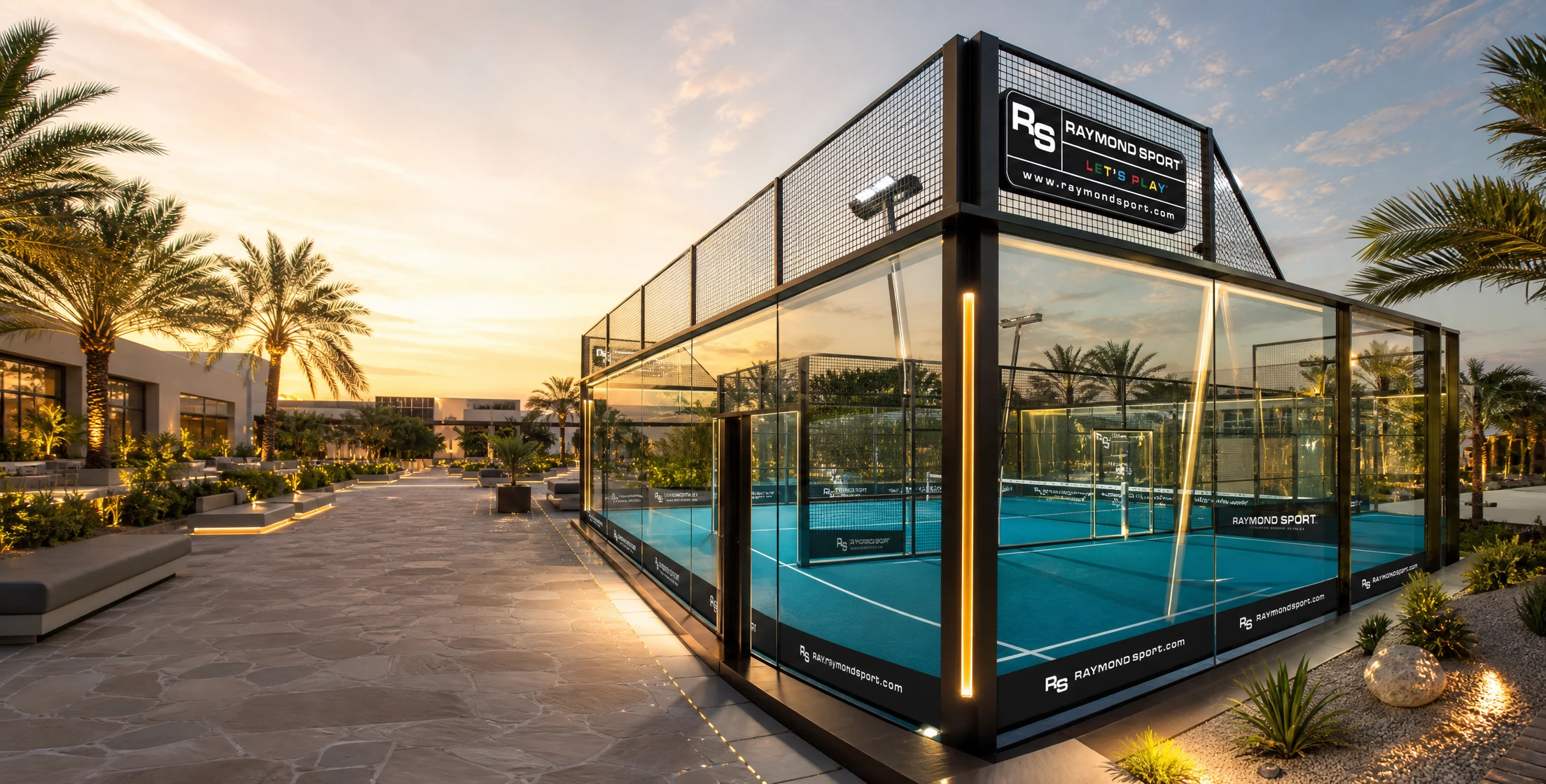
Panoramic Court
Full-glass side walls with no intermediate posts in the field of vision. Visually superior and better for spectators, broadcast and photography — the usual choice for premium hospitality and flagship club installations. Higher cost and a heavier structural requirement.
Enquire
Compact
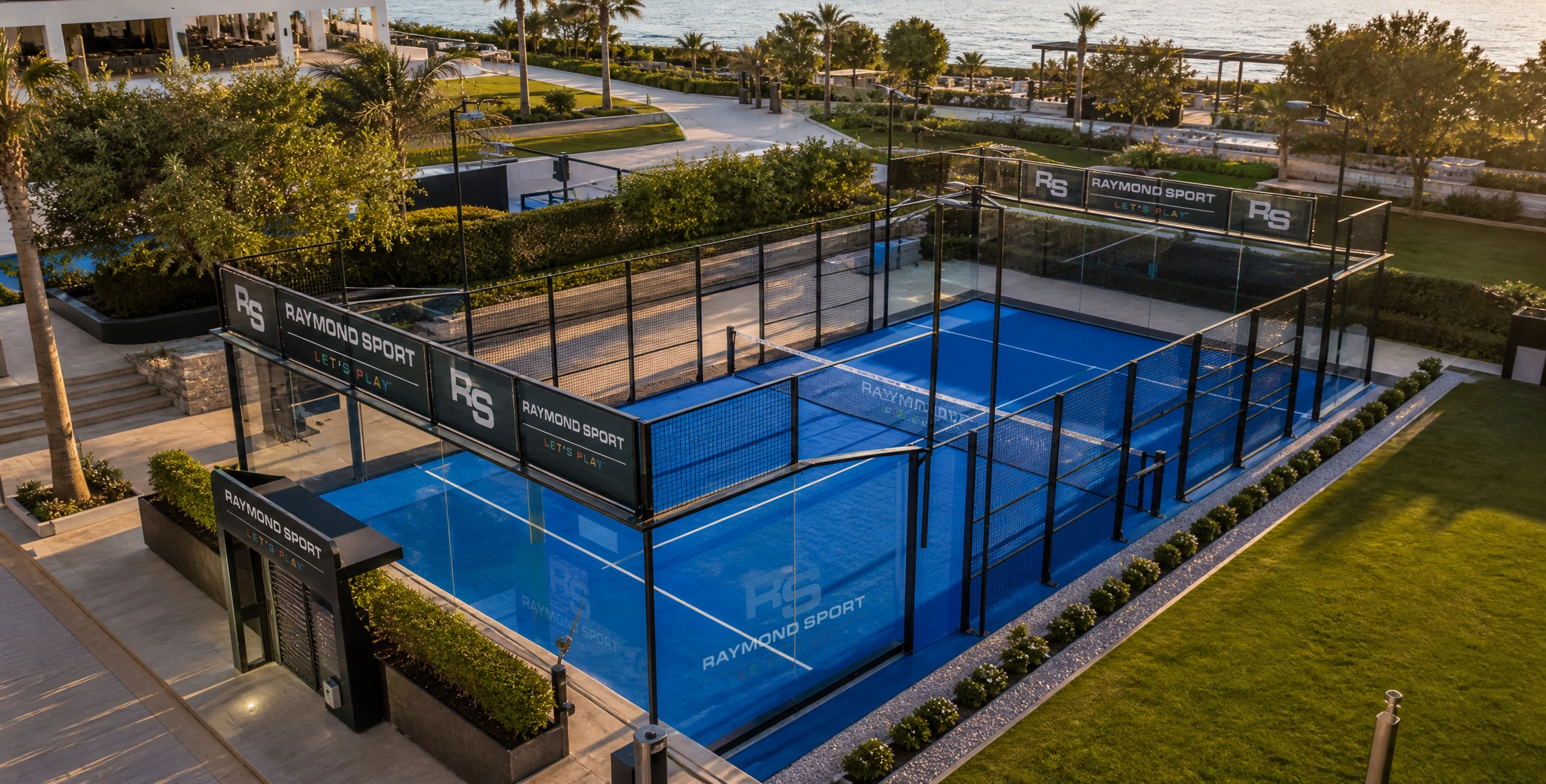
Single (Individual) Court
A narrower court — typically 20m × 6m — for one-on-one play. Suitable for villas, compact rooftops and training facilities where a full double court will not fit.
Enquire
Year-Round Play
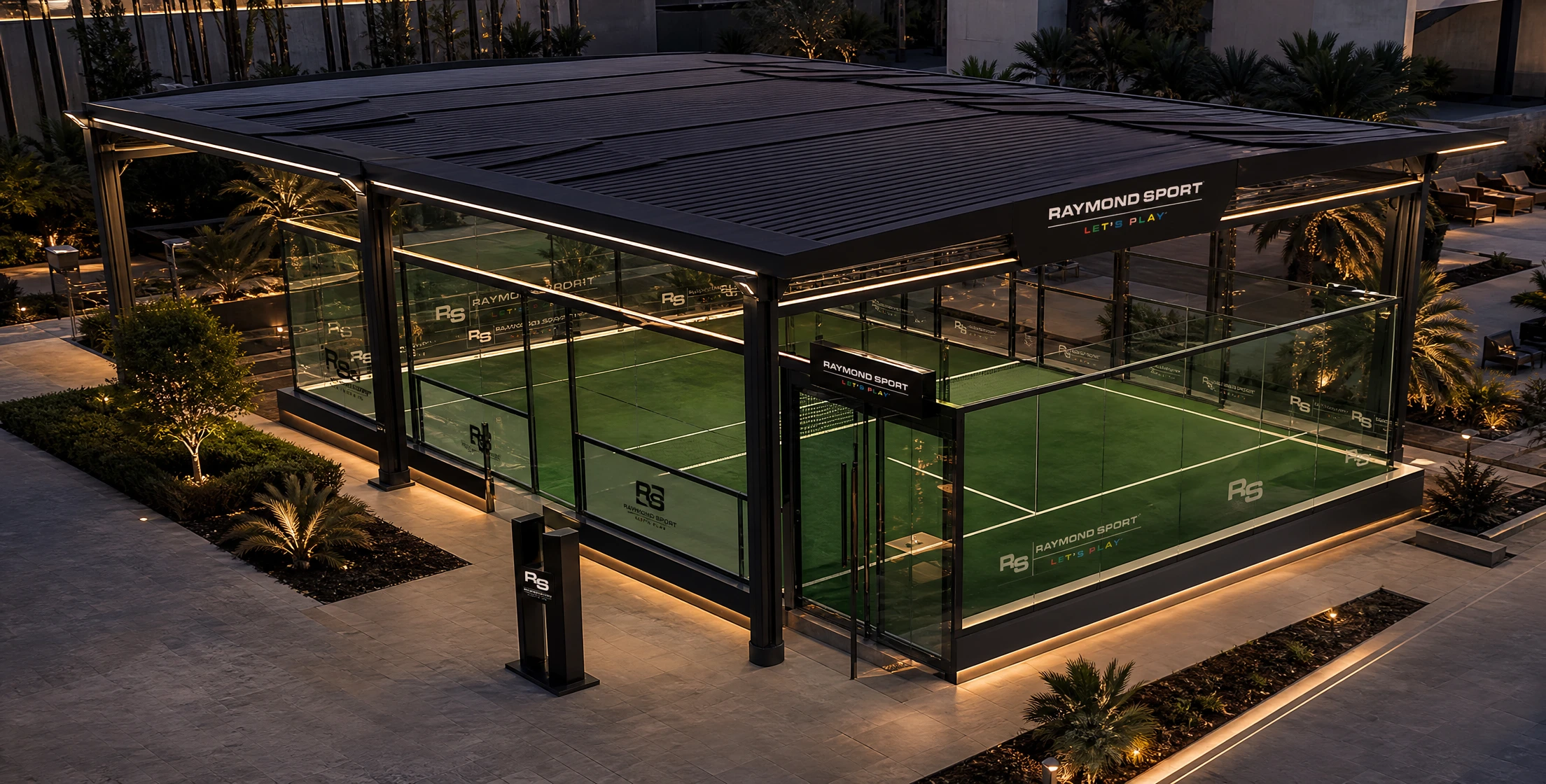
Indoor and Covered Courts
Increasingly the standard specification in the UAE. Covering a court extends usable hours across the summer months and protects turf and glass from UV degradation. Requires 6m+ clear height, with careful lighting and ventilation design to avoid glare and heat build-up.
Enquire
Dubai Specialist
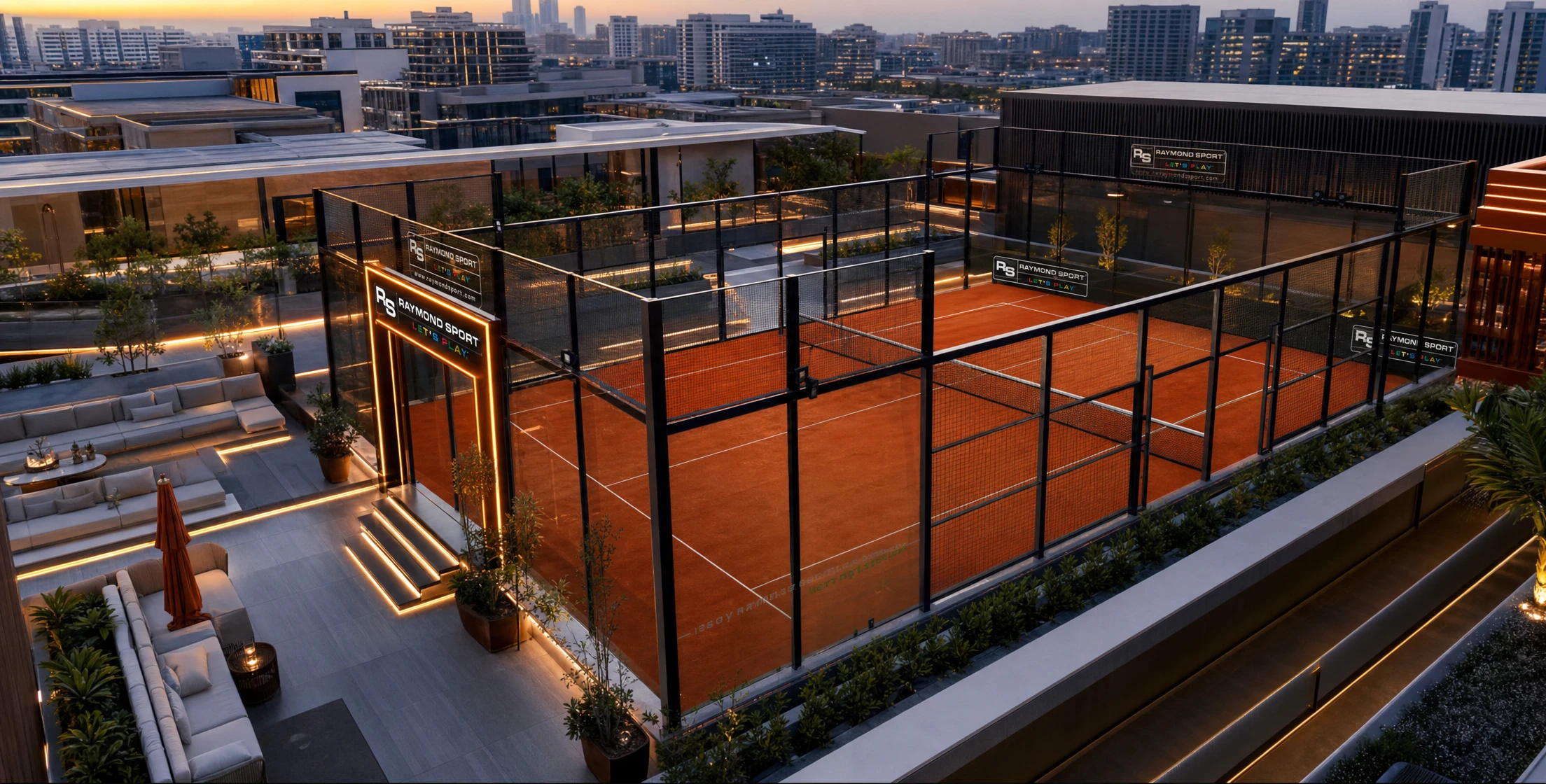
Rooftop Courts
Popular in Dubai on residential and mixed-use developments. These need structural load verification, wind loading assessment, acoustic isolation and specialist access planning. We coordinate directly with the project structural engineer from the first survey rather than discovering constraints late.
EnquireOur Padel Court Construction Process
Eight stages from first site visit to warranty handover. Every project follows the same sequence, with drawings, submittals and sign-off at each step.
-
01
Site Assessment
Levels, access, existing services, drainage and orientation. Court orientation matters — north–south alignment reduces low-sun glare and is worth planning for before anything is poured.
-
02
Design and Specification
Court type, glass thickness, turf selection, lighting layout and lux target, colour scheme. Issued to you as drawings and a written specification schedule — not a one-line quotation.
-
03
Approvals Support
We prepare material submittals, method statements and compliance documentation for consultant and authority review, and respond to comments until the package is approved.
-
04
Critical Stage
Groundworks
Excavation, compacted sub-base and reinforced concrete slab. Slab flatness and falls are set to tolerance. This is the single most important stage of the build — most padel court failures in this region trace back to the slab, not the court system.
-
05
Structure Erection
Hot-dip galvanised frame set out and levelled, tempered glass panels installed, mesh fixed and tensioned to the specified enclosure heights.
-
06
Turf Installation
Rolled, seamed, line-marked and infilled with silica sand to the manufacturer's specified rate, then brushed to set the pile so the court plays correctly from day one.
-
07
Lighting
Pole or structure-mounted LED luminaires installed, aimed and commissioned. Lux and uniformity are measured on site and reported — not assumed from the catalogue.
-
08
Handover
Snag list closed, as-built documentation, maintenance schedule and full warranty pack issued. Your team is briefed on brushing, infill top-up and inspection intervals.
Padel Court Surfaces and Turf
The turf determines how the court plays and how long it lasts. In UAE conditions, UV stability is as important as playing characteristics.
| Property | What we specify |
|---|---|
| Yarn type | Monofilament for better durability and ball response, or fibrillated where budget leads |
| Pile height | Typically 12–15mm |
| Infill | Rounded silica sand, applied at the manufacturer's specified rate |
| UV treatment | UV-stabilised yarn — non-negotiable in the Gulf |
| Colours | Blue, green, terracotta and custom club colours |
| Drainage | Permeable backing with slab falls to perimeter drainage |
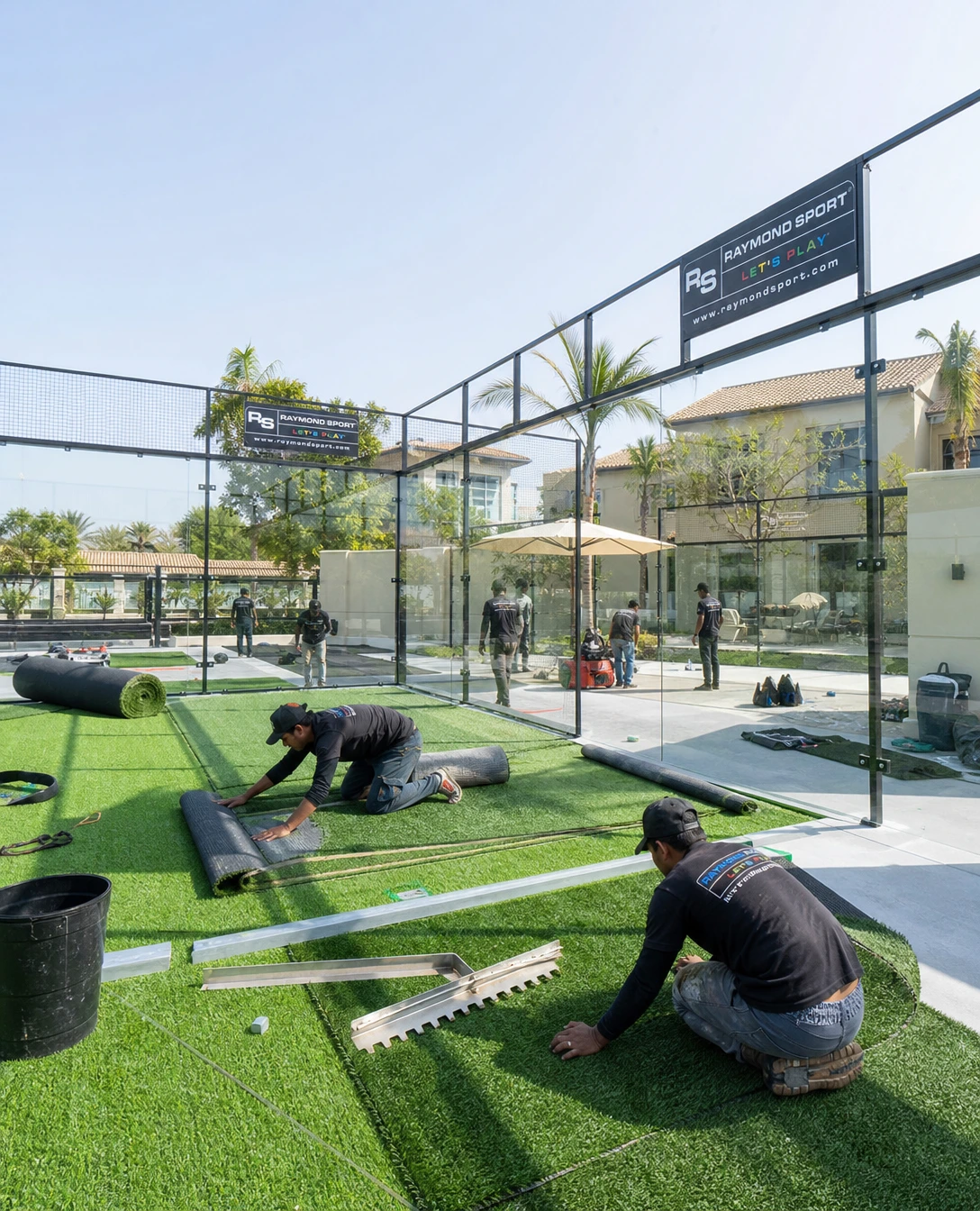
Under-specified turf is the most common false economy in padel. It looks identical on day one and visibly different after eighteen months of UAE sun — faded colour, flattened pile and a ball that no longer behaves the way players expect. Specifying correctly at the outset costs a fraction of relaying a court early.
Padel Court Lighting
Poor lighting ruins a good court. Padel is played close to glass, which makes glare control and uniformity more critical than raw output.
| Level of play | Illuminance target | Typical application |
|---|---|---|
| Recreational / community | 200–300 lux | Residential compounds, community parks, villa and rooftop courts |
| Club and general competition | 300–500 lux | Commercial padel clubs, hotels and resorts, school and university facilities |
| Official competition | 500 lux and above | Sanctioned tournament venues and federation-affiliated clubs |
| Broadcast | Per event requirement | Televised events, with flicker and colour rendering specified by the broadcaster |
Glare Control
Aimed, not flooded
Luminaires positioned and aimed to keep glare out of the players' sightline through the glass.
Uniformity
Measured on site
Even light across the full playing area, verified at commissioning rather than assumed from the datasheet.
Efficiency
LED throughout
Lower running cost and longer service life than metal halide, with instant strike for hourly court bookings.
How we design it. We work to EN 12193 lighting classes, model the layout before installation, and measure lux and uniformity at commissioning. Confirm the exact requirement with the relevant federation for any court intended to host sanctioned competition — targets vary by governing body and event category.
Padel Court Maintenance
A well-built court needs little, but it does need something. This is the schedule we hand over with every padel court we build in the UAE — follow it and the court reaches the top of its service life.
Weekly
- Brush the turf to redistribute infill and keep the pile upright
- Clear leaves, sand and debris from the playing surface
Monthly
- Check infill depth and top up where displaced, especially at the service boxes
- Clean the glass panels inside and out
Quarterly
- Inspect net tension, fixings and gate hinges
- Check lighting output and replace any failed luminaires
Annually
- Deep-clean the turf and decompact the infill
- Full structural, glass and fixing inspection
UAE outdoor conditions
Expected turf life depends on usage intensity, infill maintenance and whether the court is covered. A well-brushed, correctly infilled court under a canopy will reach the upper end of that range; a neglected outdoor court in full sun will not. Covered courts consistently outlast open ones in this climate.
Why Build Your Padel Court With Raymond Sport
Padel is new to the region. We are not. Five reasons developers, clubs and government entities across the UAE appoint us to build their courts.
38
Years in UAE
sports construction
Trading since 1987 — longer than the sport of padel has existed in this region. We were building courts, tracks and sports surfaces in the Emirates decades before the first padel club opened here.
Turnkey Delivery
Design, civils, structure, surface and lighting under one contract — no gaps between trades, no finger-pointing.
Specification-Led
FIP dimensions, EN-referenced lighting and documented material submittals. You get drawings, not promises.
Built for This Climate
UV-stabilised materials and drainage detailing designed for Gulf conditions — not imported unchanged from Europe.
Dubai & Abu Dhabi Offices
Local teams, local supply chain, local aftercare. When a panel needs replacing, we are in the same city.
Trusted by leading UAE developers, government entities and hospitality groups
Padel Court Construction: Frequently Asked Questions
The questions clients ask us most often before commissioning a padel court in the UAE.
How long does it take to build a padel court in the UAE?
A standard outdoor double court typically takes 4–6 weeks on site once approvals and materials are in place, assuming no major groundworks. Indoor and panoramic courts take longer. Lead times on glass and structure should be confirmed at order.
What size plot do I need for a padel court?
The playing area is 20m × 10m. Allow approximately 21m × 11m to accommodate the structure, plus safe access around at least one side.
Do I need approval from Dubai Municipality to build a padel court?
Requirements depend on the location, whether the court is covered, and whether it sits within a master development. Raymond Sport prepares the technical submittals and coordinates with your consultant, but formal approval is obtained through the relevant authority for your plot.
Should a padel court in the UAE be indoor or outdoor?
Outdoor courts are less expensive and perfectly viable for eight to nine months of the year. If you need year-round revenue from the court, cover it. Most commercial operators in the UAE now specify covered or indoor courts for that reason.
What is the difference between a panoramic and a standard padel court?
A panoramic court uses full-height glass on the side walls with no intermediate vertical posts in the player's field of view. It plays the same but looks considerably better and photographs better. It costs more and requires a heavier supporting structure.
How long does padel turf last?
Typically 5–8 years in UAE outdoor conditions, depending on hours of play, infill maintenance and UV exposure. Covered courts last longer.
Can you build a padel court on a rooftop?
Yes, and we have. It requires structural load verification by the building's engineer, wind loading assessment, and an access plan for materials. We coordinate that process from the start rather than discovering it late.
Do you build padel courts outside the UAE?
Yes. We deliver across the GCC, including Saudi Arabia, Qatar, Oman, Bahrain and Kuwait.
Still have a question about your project? Send us your site details and our padel team will come back with a specification and a programme.
Ask Our Team